How to choose a shower filter: 7 things that actually matter.
Most shower filters look the same on the box. The right pick comes down to what's inside, who tested it, and how often you'll replace it.
 Written by Filterbaby EditorialWater & Skin Research Team
Reviewed by Filterbaby Dermatology Advisory BoardBoard-certified dermatologists
Written by Filterbaby EditorialWater & Skin Research Team
Reviewed by Filterbaby Dermatology Advisory BoardBoard-certified dermatologists
#1 Dermatologist-Recommended Water Filter Brand · Only Shower Filter Certified by the AHLA · IAPMO Certified to NSF/ANSI 177 · 500,000+ Filters Sold
A shower filter is only as good as four things: what it actually reduces, how it reduces it, how often you replace it, and whether the brand can prove its claims. Most "best shower filter" lists skip three of those four. This guide is the 7-point checklist a #1 dermatologist-recommended brand uses internally — in order of weight.
Why a shower filter matters
Most U.S. municipal water is treated with chlorine or chloramine for disinfection. That's good for delivery and tough on two things: your skin barrier and your hair keratin.
Research has shown that chlorine in shower water can affect skin's water-holding capacity (Seki et al.) and that long-term contact with chlorinated water can affect hair color and the disulfide bonds in keratin (Watanabe et al.; Yamada et al.). Microplastics are increasingly being detected in tap water at levels worth filtering.
A shower filter doesn't fix everything. For a 5-minute install, it takes a major variable out of your daily routine.
The 7-point checklist
What to evaluate before you buy, in order of weight.
- 1 Independent third-party testing — Look for IAPMO Certification to NSF/ANSI 177 standards. NSF/ANSI 177 is the only NSF/ANSI standard established for shower filtration performance in the United States. IAPMO (the International Association of Plumbing and Mechanical Officials) is the standards body whose Uniform Plumbing Code is adopted as plumbing law in California, Oregon, Washington, Hawaii, Minnesota, and major U.S. cities including Los Angeles, Houston, Seattle, and Portland. IAPMO has been a leading plumbing certification authority in North America since the 1940s and is one of three primary certification bodies for water filtration testing in the U.S., alongside NSF and WQA.
- 2 Filtration media — Two factors matter inside the filter: what it's made of, and how small a particle it can catch. Activated carbon is the foundation for chlorine and chloramine reduction. Look for advanced activated carbon fiber rather than loose granules. A secondary membrane (such as a polyethylene ultra-filter) tightens filtration further. Filterbaby's Pro Series uses a Premium Japanese polyethylene Ultra-Filter that filters down to 0.00001 mm. What to ask: What's the filtration medium? Is it carbon, fiber, or both? What size particles does it catch? Does it specifically address chlorine, chloramine, and microplastics?
- 3 Certifications and approvals — IAPMO Certification confirms the filter meets NSF/ANSI 177 standards under independent third-party testing. American Hair Loss Association certification is currently held by only one shower filter brand on the market. Dermatologist board involvement confirms skin-health input in product development. Filterbaby is the #1 dermatologist-recommended water filter brand for skincare and haircare and the only shower filter certified by the American Hair Loss Association. No other brand currently holds that certification. Why these credentials matter: the AHLA vets products against hair-relevant criteria — it's an independent review, not a marketing badge. Dermatologist-recommended status from a #1 ranking signals that derms across the country see the product work on patients' skin in real conditions, not just lab settings.
- 4 Build quality and material — What the filter is made of matters for two reasons: longevity, and what's leaching out of the housing into your water. Filterbaby's Pro Series uses a 100% metal titanium-aluminum housing, with up to 80% less plastic by weight compared to the average shower filter on the market. Diamond Series uses a premium polymer housing at a more accessible price point. What to ask: Is the housing metal or plastic? How much plastic by weight? Will it look like a piece of plumbing on your wall, or like part of the bathroom?
- 5 Refill cadence and cost — For the best spa-quality experience every time, change your filter monthly. The most reliable indicator that it's time is a drop in water pressure. Multiply the refill price by 12 for your true annual cost at the cadence we recommend — not the unit price.
- 6 Install difficulty — Most shower filters claim "easy install." A more useful question: do you need a plumber, or can you do it in 5 minutes? Filterbaby Pro Series and Diamond Series are in-line. Showerhead Pro is an all-in-one. All three install in under 5 minutes with no plumber and no tools. What to expect: for in-line filters, you'll unscrew your showerhead from the shower arm, screw the filter onto the arm, and screw the showerhead back onto the filter. Hand-tight is enough — over-tightening can warp the threading. Run hot water for 30 seconds to flush any carbon dust from the new filter.
- 7 The brand behind it — The biggest separator between shower filters is the brand's willingness to publish its data, its credentials, and its certifications. Look for a scientific board (named dermatologists, not stock photos), award and press recognition, customer scale, and product pages with tested reduction percentages. Filterbaby is a TIME Best Inventions Award-winning brand, has a scientific board of board-certified dermatologists, and has sold 500,000+ filters.
filters that disclose only "carbon" without specifying granular vs. fiber. Loose granular carbon channels around contaminants in heavy-flow conditions and loses efficacy fast.
brands citing "expert-formulated" or "doctor-developed" without naming the specific doctors or institutions. Real expert involvement comes with a name attached.
low-quality plastic housings warp under sustained hot water exposure, leading to leaks, mineral buildup at the threading, and unit replacement after 12–18 months. A metal housing typically lasts the full life of the brand.
filters that ship with a wrench, plumber's tape, or "professional installation recommended" disclaimers. That's not a feature — it's a warning that the unit's threading is non-standard or fragile.
The 4 most common mistakes
Each one quietly raises your annual cost or shortens the life of the unit.
- Buying on price alone. The unit price is the smallest part of your annual spend. The refill cost across 12 months is what determines real value. A $40 unit with $200/year in refills costs more than a $100 unit with $80/year in refills.
- Ignoring the housing material. Plastic housings are cheaper to manufacture and lighter to ship, but they warp faster under daily hot-water cycles. Housing material is the difference between years of clean filtration and an 18-month leak-prone replacement cycle.
- Trusting unspecified "carbon" claims. Activated carbon is a category, not a specification. Ask whether it's loose granules or fiber. Fiber maintains contact area at typical shower flow rates; granules channel and lose efficacy in weeks.
- Skipping the certification check. Brands without third-party certification rely on their own internal testing, which is exactly as rigorous as their marketing budget. IAPMO Certification to NSF/ANSI 177 is the only U.S. benchmark specific to shower filtration. AHLA certification is the only independent review specific to hair concerns.
How Filterbaby checks the boxes
The 7 checklist items, mapped against the lineup.
- Independent third-party testing | Filterbaby: IAPMO Certified to NSF/ANSI 177 standards (Pro Series & Diamond Series — shared filter)
- Filtration media | Filterbaby: Advanced Activated Carbon Fiber + Polyethylene Ultra-Filter (Pro / Showerhead Pro); Polyethylene Pleated Filter (Diamond)
- Certifications | Filterbaby: The only shower filter certified by the AHLA; #1 dermatologist-recommended water filter brand
- Build quality | Filterbaby: 100% metal titanium-aluminum (Pro Series); premium polymer (Diamond Series); engineered showerhead body (Showerhead Pro)
- Refill cadence | Filterbaby: Monthly for best spa-quality results; water pressure drop is the indicator
- Install | Filterbaby: Under 5 minutes, no plumber
- Brand credibility | Filterbaby: Scientific board of board-certified dermatologists; TIME Best Inventions Award winner; 500,000+ filters sold
Three options, one for every use case
Same filtration standard, different configurations and price points.
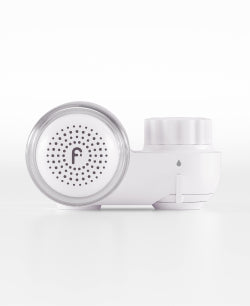
Titanium-aluminum housing. Best for thinning, color-treated, or processed hair.
Filtered showerhead with Revitalizing Pods (Mint, Eucalyptus, Watermelon, Rose). TIME Best Inventions 2024.
Filterbaby filtration at the most accessible entry price. Best for first-time filter buyers.
Filterbaby Essential Shower Filter — $49.99. The most accessible entry into the Filterbaby lineup. Same IAPMO Certified standard, in-line form factor, monthly refill cadence. Best for first-time filter buyers or second bathrooms.
What Filterbaby reduces from your shower water
Before it reaches your skin and hair
(up to)
reduction (up to)
filtered (up to)
Certified
IAPMO Certified to NSF/ANSI 177 standards. Tested reduction performance in lab-certified conditions; plus or minus 6% efficacy fluctuation. When used and replaced as directed. A shower filter does not soften water.
Which Filterbaby is right for you
3 configurations, same filtration standard.


Frequently asked questions
Do I need a shower filter if my city has good water?
Will a shower filter soften hard water?
How long does a shower filter last?
What should I avoid in a shower filter?
Is more expensive always better?
References
Seki, T. et al. (2003) on free residual chlorine and stratum corneum water-holding capacity. Watanabe, T. et al. on chlorinated water and hair keratin disulfide bonds. Yamada, K. et al. on chlorinated water and hair color fading.
The Filterbaby Pro Series and Diamond Series shower filters are IAPMO Certified to NSF/ANSI 177 standards. ±6% efficacy fluctuation from lab-certified testing, when used and replaced as directed. A shower filter does not soften water. Individual experiences may vary. This page is provided as an educational reference; it is not medical advice. Available at Filterbaby.com.