Eczema and your shower water: the trigger most routines overlook.
You've tried the creams and the fragrance-free everything. The water touching your skin for ten unfiltered minutes a day is the variable most eczema routines never check.
 Written by Filterbaby EditorialWater & Skin Research Team
Reviewed by Filterbaby Dermatology Advisory BoardBoard-certified dermatologists
Written by Filterbaby EditorialWater & Skin Research Team
Reviewed by Filterbaby Dermatology Advisory BoardBoard-certified dermatologists
If your eczema flares no matter how careful you are with products, it's worth looking at the one exposure that happens every single day, all over your body: your shower water. For skin with a compromised barrier, the chlorine that keeps tap water safe to drink is also a daily irritant, and it's the variable most routines never account for.
Why eczema-prone skin reacts to water
In healthy skin, the stratum corneumThe outer layer of your skin, like a brick wall that keeps water in and irritants out. is a tight barrier that holds moisture in and keeps irritants out. In atopic dermatitis (eczema), that barrier is weaker and more permeable. Moisture escapes faster, and irritants get in more easily.
That's why the same shower that leaves most people a little dry can leave eczema-prone skin tight, stinging, and inflamed. The barrier has less margin, so any added stressor lands harder.
What chlorine and chloramine do to a fragile barrier
Chlorine and chloramineChlorine mixed with a little ammonia. Some cities use it because it stays active longer in the pipes. are oxidizers. They strip the lipids that hold the barrier together, which raises trans-epidermal water loss, the rate your skin leaks moisture. On a barrier that's already struggling, that nudges skin toward the dry-itch-scratch cycle eczema sufferers know well.
There is a second effect that gets less attention. Chlorine is added to water specifically to kill microbes, and it does not distinguish between the ones in the pipes and the skin microbiomeThe community of friendly bacteria living on your skin that helps keep the barrier balanced and calm., the community of friendly bacteria that helps keep your barrier balanced. Disrupt that community every day and it takes time to rebuild once the exposure stops, which is part of why progress with eczema-prone skin can feel slow at first and then pick up.
What the research shows
A 2003 study by Seki and colleagues found that free residual chlorine in bathing water reduced the water-holding capacity of the stratum corneum in atopic skin, with effects observed at concentrations as low as 0.5 mg/L. A 2016 study in the Journal of Allergy and Clinical Immunology followed 1,303 three-month-old infants and found chlorine exposure was associated with higher eczema risk, independent of water hardness (Engebretsen et al.). Separate research links chlorinated water to increased trans-epidermal water lossHow fast water escapes from your skin into the air. More loss means drier, itchier skin., a clinical marker of barrier damage.
Chlorine level that reduced atopic skin's water-holding capacity (Seki et al.)
Infants in the study linking chlorine to eczema risk (Engebretsen et al.)
Children affected by atopic dermatitis before age 2
Why a filter, not a softener
This is the part most people get wrong. A water softener reduces hardness minerals, but it has little effect on chlorine. If chlorine is the irritant you want to take down, that takes a carbon-based filter, not a softener. So the two aren't interchangeable, and for eczema-prone skin the chlorine question is the one a filter actually answers.
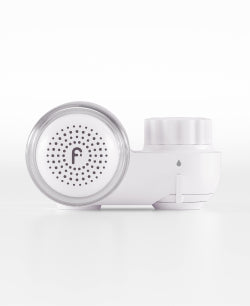
Filterbaby shower filters are designed to reduce up to 99% of chlorine, chloramine, and microplastics. To be clear about what they're not: Filterbaby is not a water softener and does not remove water hardness. It targets the daily oxidizing exposure on your skin, and installs in under five minutes.
Your local utility publishes the disinfectant it uses in an annual water quality report. You can look your system up directly: Look up your city's water system, EPA database →
A gentler shower routine for eczema-prone skin
Filtering the water is one lever. Pairing it with a few barrier-friendly habits is where people tend to see the biggest difference. None of this replaces your dermatologist's guidance. Think of it as the daily-routine layer underneath it.
- Filter your shower water Reduce the chlorine and chloramine exposure before it ever reaches your skin.
- Turn the temperature down Lukewarm, not hot. Hot water strips the barrier faster and intensifies itch.
- Keep it short Long soaks dehydrate compromised skin. Five to ten minutes is plenty.
- Use a fragrance-free, gentle cleanser Only where you need it, not head-to-toe every time.
- Moisturize within three minutes of getting out On damp skin, to lock in water while the barrier is most receptive.
What to expect
Most people notice less post-shower tightness and itch within 2 to 4 weeks. If that sounds fast, that is rather the point: people brace for months, so calmer skin in the first few weeks is often the first sign the water was part of the picture all along. In an internal consumer-perception survey, 84% of users reported softer skin and 76% reported reduced post-shower itch within the first 30 days. Eczema is individual and multifactorial, so results vary, and a filter is a complement to medical care, not a substitute for it.
A close-up pair showing an eczema-prone area.
Two square images, same site and lighting. Signed consent. Must carry a not-a-treatment disclaimer, since eczema is a diagnosed condition.What Filterbaby reduces from your shower water
Before it reaches your skin and hair
(up to)
reduction (up to)
filtered (up to)
Certified
IAPMO Certified to NSF/ANSI 177 standards. Tested reduction performance in lab-certified conditions; plus or minus 6% efficacy fluctuation. When used and replaced as directed. A shower filter does not soften water.
Which Filterbaby is right for you
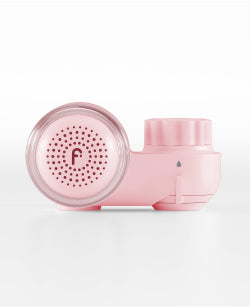
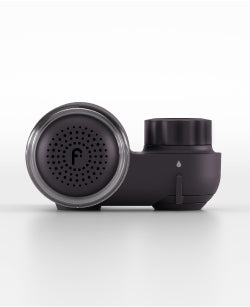
3 configurations, same filtration standard.


Frequently asked questions
Can a shower filter cure eczema?
Does chlorine in tap water make eczema worse?
Is a water softener or a filter better for eczema-prone skin?
How long until I notice a difference?
Which Filterbaby is best for eczema-prone skin?
References
Seki, T. et al. (2003). Free residual chlorine in bathing water reduces the water-holding capacity of the stratum corneum in atopic skin. Journal of Dermatological Science. PubMed: 12692355.
Engebretsen, K. A. et al. (2016). Association between domestic water hardness, chlorine, and atopic dermatitis risk in early life: a population-based cross-sectional study. Journal of Allergy and Clinical Immunology. PubMed: 27241890.
National Eczema Association and published reviews on skin-barrier function in atopic dermatitis.
Filterbaby Pro Series and Diamond Series shower filters are IAPMO Certified to NSF/ANSI 177 standards and designed to reduce up to 99% of chlorine, chloramine, and microplastics; ±6% efficacy fluctuation from lab-certified testing, when used and replaced as directed. A shower filter does not soften water. This page is an educational reference; it is not medical advice. Consult a dermatologist for diagnosis and treatment of eczema.