Chlorine vs. chloramine: what's actually in your shower water.
Most U.S. cities disinfect with one of two chemicals, and the one quietly taking over is the harder one to filter. Here's the difference, and what each does to skin and hair.
 Written by Filterbaby EditorialWater & Skin Research Team
Reviewed by Filterbaby Dermatology Advisory BoardBoard-certified dermatologists
Written by Filterbaby EditorialWater & Skin Research Team
Reviewed by Filterbaby Dermatology Advisory BoardBoard-certified dermatologists
If your skin feels tight after a shower, your scalp itches, or your color fades faster than it should, the water itself is the variable most routines never check. And what's in that water comes down to how your city disinfects it: with chlorine, or increasingly, with chloramineChlorine mixed with a little ammonia. Water companies use it because it stays active longer in the pipes.. They behave differently, they feel different on skin, and one is meaningfully harder to filter than the other.


Why tap water is disinfected at all
Disinfection is one of the great public-health wins of the last century. Adding a chemical residual to municipal water keeps it free of waterborne pathogens all the way from the treatment plant to your tap. The EPA and CDC consider both chlorine and chloramine safe to drink at regulated levels, and that's not in dispute.
The catch is that the same residual that protects the water in the pipe is still active when it lands on your skin and hair. Chlorine and chloramine are oxidizersChemicals that slowly wear things down, the same way air and water rust metal.. For a glass of water, that's a non-issue. For ten minutes of hot, full-body contact every day, it's the variable worth understanding.
Chlorine: what it does to skin and hair
Free chlorine in U.S. tap water typically runs between 0.2 and 4.0 ppm. As an oxidizer, it strips the lipidsThe natural oils between your skin cells that act like glue and hold moisture in. that hold the skin barrier together, which raises trans-epidermal water loss, the rate at which your skin leaks moisture. That's the mechanism behind post-shower tightness, flaking, and itch.
The research is specific. A 2003 study by Seki and colleagues found that free residual chlorine in bathing water reduced the water-holding capacity of the stratum corneumThe outer layer of your skin, like a brick wall that keeps water in and irritants out. in atopic skin, with effects observed at concentrations as low as 0.5 mg/L. A 2016 population study in the Journal of Allergy and Clinical Immunology found chlorine exposure was independently associated with eczema risk, even after controlling for water hardness. On hair, chlorine oxidizes the disulfide bonds in keratin and accelerates color fade.
Chloramine: why your city may have switched
Chloramine is chlorine combined with a small amount of ammonia. Utilities like it for one big reason: it's stable. It holds its disinfecting power far longer as water travels through miles of pipe, and it produces fewer regulated disinfection byproducts than chlorine. About 1 in 5 Americans now receive chloramine-treated water, and roughly a third of U.S. public water systems use it.
That stability is exactly what makes chloramine harder to deal with at home. Free chlorine off-gasses. Leave a glass out overnight and much of it is gone. Chloramine doesn't. It won't evaporate if water sits, and boiling isn't a reliable way to remove it. Reducing it takes a filter with enough carbon and enough contact time to do the work. A thin, cheap cartridge that handles chlorine may barely touch chloramine.
- What it is | Chlorine: Free chlorine residual | Chloramine: Chlorine + ammonia
- Why utilities use it | Chlorine: Strong, fast disinfectant | Chloramine: Stable, longer-lasting in pipes; fewer byproducts
- Off-gasses if water sits? | Chlorine: Yes, largely dissipates | Chloramine: No, chemically stable
- Ease of filtering | Chlorine: Relatively easy | Chloramine: Harder, needs more carbon & contact time
- On skin & hair | Chlorine: Oxidizes barrier lipids & keratin | Chloramine: Same oxidizing effect; lingers longer
Microplastics: the third variable
Disinfectant isn't the only thing coming out of your tap. A landmark Orb Media investigation, with samples analyzed at the University of Minnesota, found that 83% of tap-water samples across five continents contained microscopic plastic fibers, including water from the U.S. EPA's own headquarters. MicroplasticsPlastic pieces so small you can't see them, now found in a lot of tap water. are a newer and still-developing area of research, but they're increasingly detected at levels worth filtering, which is why a good point-of-use filter targets them alongside chlorine and chloramine.
Americans on chloramine-treated water (EPA)
Chlorine level that reduced atopic skin's water-holding capacity (Seki et al.)
Of global tap-water samples contained microplastic fibers (Orb Media)
How to find out what's in your water
You don't have to guess. Every U.S. utility publishes an annual Consumer Confidence Report (also called a water quality report) that lists the disinfectant it uses. Search your city's name plus "water quality report," or check your provider's website. If it says chloramine, prioritize a filter built to handle it, not every filter is.
One thing the report won't change: chlorine and chloramine are about disinfection, not hardness. If your water is "hard," that's dissolved minerals, a separate issue that a point-of-use filter doesn't address. Be wary of any product that blurs the two.
What reduces them at the point of use
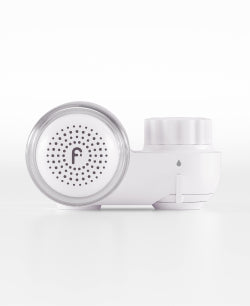
For the water you actually wash with, a point-of-use filter is the practical fix. Filterbaby shower filters are designed to reduce up to 99% of chlorine, chloramine, and microplastics, installed in under five minutes with no plumber. The Pro Series and Diamond Series shower filters are independently certified to NSF/ANSI 177 by IAPMO, and the Filterbaby shower filter is the only shower filter approved by the American Hair Loss Association.
DESIGNED TO REDUCE — UP TO 99% AT THE POINT OF USE. Chlorine up to 99%. Chloramine up to 99%. Microplastics up to 99%.
Filterbaby shower filters are designed to reduce up to 99% of chlorine, chloramine, and microplastics. Pro Series & Diamond Series are IAPMO Certified to NSF/ANSI 177. ±6% efficacy fluctuation from lab-certified testing, when used and replaced as directed.
What a shower filter is not is a water softener. It reduces chlorine, chloramine, and microplastics; it does not remove water hardness, and it isn't a whole-house system. If your goal is taking the daily oxidizing exposure off your skin and hair, that's exactly the job it's built for.
Chlorine is the easier one to filter and the one that off-gasses. Chloramine is more stable, more persistent, and harder to remove, so the filter you choose matters more if your city uses it. Filterbaby reduces both, plus microplastics, at the point of use. Find your filter
What Filterbaby reduces from your shower water
Before it reaches your skin and hair
(up to)
reduction (up to)
filtered (up to)
Certified
IAPMO Certified to NSF/ANSI 177 standards. Tested reduction performance in lab-certified conditions; plus or minus 6% efficacy fluctuation. When used and replaced as directed. A shower filter does not soften water.
Which Filterbaby is right for you
3 configurations, same filtration standard.


Frequently asked questions
Is chloramine worse than chlorine for skin and hair?
How do I know whether my water has chlorine or chloramine?
Does boiling or letting water sit remove chloramine?
Can a shower filter reduce chloramine?
Is chloramine safe to drink?
Does Filterbaby remove water hardness?
References
Seki, T. et al. (2003). Free residual chlorine in bathing water reduces the water-holding capacity of the stratum corneum in atopic skin. Journal of Dermatological Science. PubMed: 12692355.
Engebretsen, K. A. et al. (2016). Association between domestic water hardness, chlorine, and atopic dermatitis risk in early life. Journal of Allergy and Clinical Immunology.
U.S. EPA. Chloramines in Drinking Water. epa.gov/dwreginfo/chloramines-drinking-water.
Orb Media / University of Minnesota School of Public Health (2017). Global tap-water microplastics investigation: 83% of samples contained plastic fibers.
Filterbaby Pro Series and Diamond Series shower filters are IAPMO Certified to NSF/ANSI 177 standards. Designed to reduce up to 99% of chlorine, chloramine, and microplastics; ±6% efficacy fluctuation from lab-certified testing, when used and replaced as directed. A shower filter does not soften water. Individual experiences may vary. This page is an educational reference; it is not medical advice.