How hot should your shower be? And what the heat actually does.
Everyone tells you hot showers ruin your skin. The evidence for that is thinner than the advice suggests, and the temperature effect that is genuinely well measured is one almost nobody mentions.
 Written by Filterbaby EditorialWater & Skin Research Team
Reviewed by Filterbaby Dermatology Advisory BoardBoard-certified dermatologists
Written by Filterbaby EditorialWater & Skin Research Team
Reviewed by Filterbaby Dermatology Advisory BoardBoard-certified dermatologists
Everyone repeats that hot showers wreck your skin. It is one of those pieces of advice that sounds obviously true, gets restated in every skincare article, and turns out to rest on a much smaller pile of evidence than you would expect. Here is what is actually established, what is guesswork, and the one temperature effect that is genuinely well measured and almost never mentioned.

What the dermatologists actually say
The American Academy of Dermatology is consistent across its guidance. For dry skin: limit baths and showers to five to ten minutes, using warm water, and moisturise while skin is still damp. For psoriasis: showers to five minutes, baths to fifteen, warm and not hot, moisturiser within five minutes. For children with eczema: warm not hot, five to ten minutes.
What no US body publishes is a number. Not the AAD, not the National Eczema Association, not any federal agency. Every specific figure circulating online, whether it is 98F or 105F or 37C, was invented by consumer media or product marketing. If you see one attributed to the AAD, the attribution is wrong.
The AAD grades its own bathing advice at its lowest evidence tier. Its 2014 clinical guideline states directly that there is no standard for the frequency or duration of bathing appropriate for atopic dermatitis, and that most recommendations stem from expert consensus and personal experience. That does not make the advice wrong. It makes it advice rather than data, and the difference is worth carrying into the rest of this article.
Does heat actually damage the barrier
This is where the popular claim gets shakier than expected. There is no modern trial that showered people at two temperatures and measured their skin. The temperature literature is three small European studies from the mid-1990s, and almost all of it used detergent rather than plain water.
The most revealing is a Danish study of 20 volunteers who immersed forearms twice daily for two days, with left and right arms randomised to 20C and 40C. Half used a detergent solution, half used sterile water.
An Italian study of ten volunteers found the same direction, with irritation rising steadily from 4C to 40C, though it had no water-only control to separate hot water from hot detergent. A Belgian study found measurably more irritation at 40C than at 37C, which is a strikingly narrow gap inside the normal shower range.
So the defensible version of the claim is narrower than the one you usually read. Hotter water makes your cleanser harsher. Hot water on its own, in the one study that isolated it, did not measurably damage the barrier.
And a complication worth holding: a German study of 41 people found that regular sauna users had more stable barrier function, better hydration and faster recovery than non-users, at 80C. Repeated extreme heat improved the measures. That does not disprove anything about showers, but it does make "heat destroys your skin barrier" untenable as a blanket statement.
- The detergent arm at 40C showed significantly increased transepidermal water loss compared with the same detergent at 20C.
- The plain water arm showed no significant change in any measured parameter, at either temperature.
The oil-stripping claim
You have read that hot water strips your skin's natural oils. We went looking for the study behind it.
There is not one. No human study has measured skin surface lipid or stratum corneumThe outermost layer of skin. Its lipids are what hold moisture in and keep irritants out. lipid removal as a function of wash water temperature. Every number attached to that claim online is unsourced.
The mechanism is plausible. US researchers identified a solid-to-fluid transition in a subset of skin barrier lipids near 35C, and shower water sits above that. Plausible is a reasonable thing to say. Measured is not, and we are not going to pretend otherwise.
The effect nobody mentions
Here is the temperature effect that is genuinely well quantified, and it has nothing to do with dryness.
In a US study run by Battelle with EPA co-authors, ten people bathed in chlorinated water while breathing pure air through a full face mask, which removed inhalation from the equation entirely. Seven of them bathed at multiple temperatures between 30C and 40C.
At the highest temperature they exhaled roughly 30 times more chloroform than the same people at the lowest. The explanation is blood flow: cold constricts the vessels near the skin and lengthens the diffusion path, warmth opens it up.
There is a second mechanism on top of that. Heating water does not only drive existing trihalomethanesA family of byproducts formed when chlorine reacts with organic matter in water. Chloroform is the most common. out of solution, it creates more of them. A Rutgers study found trihalomethane exposures calculated from heated water ran about 50% higher than those calculated from cold. And a University of Pittsburgh shower chamber study found water temperature had a dominant effect on how much volatilised into the air, outranking both flow rate and airflow.
For scale on the shower itself: a CDC study of 100 volunteers taking ten-minute showers found total trihalomethanes in the air rose about 60-fold during the shower, and in the blood about 18-fold.
Two honest caveats. The 30C comparison point is colder than any shower a person would actually take, so this is not a claim that hot showers poison you. And the temperature-response work dates to the mid-1990s and has not been repeated in the US since. What it does establish is that turning the tap hotter increases what your skin takes up from the water, which makes what is in the water matter more.
A realistic routine
The average US shower is 7.8 minutes, unchanged in two decades of measurement, and showers are the single largest use of household hot water at 39% of it. None of what follows requires you to suffer.
- Warm rather than hot, and let the cleanser decide. The strongest finding in this literature is that heat makes detergent harsher. If you like a hot shower, the higher-leverage change is a gentler cleanser and less of it, not a colder tap.
- Moisturise on damp skin, within a few minutes. This is the best-supported step on the page. In a US study, bathing alone left skin at 91% of baseline hydration, below where it started. Bathing plus moisturiser fixed that.
- Do not assume shorter is always better. The only decent US randomised trial in children with eczema found that longer, twice-daily soaks beat short twice-weekly ones by 21 points on a severity score, as long as moisturiser followed. The seal matters more than the clock.
- Set your water heater to 120F. The Consumer Product Safety Commission's recommendation. For scale, 140F causes a third-degree burn in six seconds, and 120F can do it in five minutes, which is roughly the length of a shower.
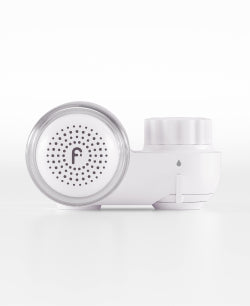
- Filter what you are standing in. Since warmth increases what your skin absorbs from the water, reducing the disinfectant in it is the input you can actually control. Filterbaby is designed to reduce up to 99% of chlorine, chloramine, and microplastics.
- Keep filtered water under 100F for filter performance. Our own guidance, and worth knowing that the NSF/ANSI 177 test protocol runs at 40C. Very hot water shortens the working life of any carbon media.
When to see a doctor
One thing in this area is genuinely clinically important and almost never covered in articles like this.
If a warm shower reliably triggers intense itching, tingling, stinging or burning within minutes, with no visible rash, that is aquagenic pruritusItching triggered by contact with water of any temperature, without any visible skin change., and it is worth mentioning to a doctor. It is a recognised presenting sign of polycythemia vera and related blood disorders. In a study of 441 patients with that diagnosis, 68% had aquagenic pruritus, and in most of them it preceded the diagnosis by an average of nearly three years. Only 15% had it prompt a blood workup.
Hot showers are also a well-documented trigger for rosacea flushing, reported by 51% of respondents in a survey of 1,066 US patients, and for cholinergic urticaria, where a hot bath is used as a diagnostic test.
The case against hot showers is weaker than the internet suggests. What is established is that heat makes your cleanser harsher, and that bathing without moisturising afterwards leaves you drier than when you started. The best-measured effect of turning the tap hotter is not what it takes out of your skin. It is what it moves into it from the water. Which is an argument for caring about the water rather than for suffering through a cold shower.
What Filterbaby reduces from your shower water
Before it reaches your skin and hair
(up to)
reduction (up to)
filtered (up to)
Certified
IAPMO Certified to NSF/ANSI 177 standards. Tested reduction performance in lab-certified conditions; plus or minus 6% efficacy fluctuation. When used and replaced as directed. A shower filter does not soften water.
Which Filterbaby is right for you
3 configurations, same filtration standard.


Frequently asked questions
What temperature should my shower be?
Do hot showers really dry out your skin?
Does hot water strip your skin's natural oils?
How long should a shower be?
Does shower temperature affect what I absorb from the water?
Is hot water bad for hair?
When should I see a doctor about this?
References
Bathing guidance from the American Academy of Dermatology: Dermatologists' top tips for relieving dry skin, 8 ways to stop baths and showers from worsening your psoriasis, and Eczema: tips to help your child feel better. Soak and seal protocol from the National Eczema Association, Managing Atopic Dermatitis (2024).
Evidence grading from Eichenfield, Tom, Berger and colleagues, Guidelines of care for the management of atopic dermatitis, section 2, Journal of the American Academy of Dermatology (2014). Bathing practices are graded strength of recommendation C, level of evidence III.
Water temperature and barrier function from Ohlenschlaeger, Friberg, Ramsing and Agner, Acta Dermato-Venereologica (1996), 20 volunteers; Berardesca and colleagues, Contact Dermatitis (1995), 10 volunteers; and Clarys, Manou and Barel, Contact Dermatitis (1997). Sauna barrier findings from Kowatzki and colleagues, Dermatology (2008), 41 volunteers.
Skin barrier lipid phase transitions from Gay, Guy, Golden and colleagues, Journal of Investigative Dermatology (1994). We found no human study measuring lipid removal as a function of wash water temperature.
Temperature and dermal absorption from Gordon, Wallace, Callahan, Kenny and Brinkman, Environmental Health Perspectives (1998), 10 subjects, US EPA and Battelle; and Corley, Gordon and Wallace, Toxicological Sciences (2000).
Heated water and trihalomethane formation from Weisel and Chen, Risk Analysis (1994). Shower volatilisation from Giardino and Andelman, Journal of Exposure Analysis and Environmental Epidemiology (1996). Shower air and blood levels from Silva, Backer, Ashley and colleagues, CDC Division of Laboratory Sciences, Journal of Exposure Science and Environmental Epidemiology (2013), 100 volunteers.
Bathing and hydration from Chiang and Eichenfield, Pediatric Dermatology (2009), 10 subjects. Bathing frequency trial from Cardona, Kempe, Lary and colleagues, Journal of Allergy and Clinical Immunology: In Practice (2020), 42 children randomised.
US shower duration and hot water share from DeOreo, Mayer, Dziegielewski and Kiefer, Residential End Uses of Water, Version 2, Water Research Foundation (2016), 762 flow-monitored homes. Scald thresholds and heater setting from the US Consumer Product Safety Commission, Tap Water Scalds, publication 5098.
Aquagenic pruritus from Siegel, Tauscher and Petrides, American Journal of Hematology (2013), 441 patients. Rosacea triggers from the National Rosacea Society patient survey, 1,066 respondents.
Filterbaby Pro Series and Diamond Series shower filters are IAPMO Certified to NSF/ANSI 177 standards and designed to reduce up to 99% of chlorine, chloramine, and microplastics; plus or minus 6% efficacy fluctuation from lab-certified testing, when used and replaced as directed. A shower filter does not soften water. This page is provided as an educational reference; it is not medical advice. Consult a board-certified dermatologist about persistent skin symptoms.
Keep reading
- How much chlorine is in your shower waterWhat the warmth is helping your skin absorb, in EPA numbers.
- Eczema and your shower water: the trigger most routines overlookFor skin that is dry and easily irritated.
- Hair loss and your shower water: what the research separatesBreakage, shedding, and which one you actually have.