How much chlorine is in your shower water: and how to look up yours.
Your utility measures it, publishes it every year, and almost nobody reads it. The numbers are more interesting than you would expect, and one of them says the shower matters more than the glass.
 Written by Filterbaby EditorialWater & Skin Research Team
Reviewed by Filterbaby Dermatology Advisory BoardBoard-certified dermatologists
Written by Filterbaby EditorialWater & Skin Research Team
Reviewed by Filterbaby Dermatology Advisory BoardBoard-certified dermatologists
Chlorination is one of the best public health decisions of the last century, and nothing here argues against disinfecting water. The point is narrower. A disinfectant is designed to still be chemically active when it reaches the far end of the pipe, which means it is also still active when it hits your skin for ten minutes every morning.

The numbers, from the EPA's own data
Two figures matter. The ceiling, and the reality.
The ceiling is the maximum residual disinfectant levelThe highest average level of disinfectant the EPA allows a water system to carry. Written as MRDL., set at 4.0 mg/L for both chlorine and chloramine. The reality comes from EPA's Six-Year Review compliance monitoring, drawing on hundreds of thousands of distribution system samples across 34 states.
One thing worth understanding, because it changes how you read a compliance claim. The 4.0 mg/L limit is assessed as a running annual average, computed quarterly, across the whole distribution systemThe network of mains and service lines carrying treated water from the plant to your building. Water changes chemically as it travels.. That is a sensible way to regulate a utility. It says almost nothing about what came out of your showerhead this morning. Individual readings move with season, water temperature, and how far you sit from the treatment plant.
So a system being in compliance and your water being low in chlorine today are two separate claims. Both can be true, and neither implies the other.
Chlorine and chloramine are not the same
Free chlorine is the older approach. Strong oxidizerA chemical that slowly wears things down, the same way air and water rust metal., dissipates relatively quickly, and it is the source of that pool smell.
Chloramine is chlorine combined with ammonia. Utilities have moved toward it in large numbers because it is far more stable in distribution pipes and produces fewer regulated byproducts.
That stability is the catch. The property that makes chloramine useful to a utility is the same property that makes it harder to remove at your tap. It does not off-gas the way free chlorine does, so letting water sit out does very little. Filter media that handles free chlorine easily does not necessarily handle chloramine at the same rate. This is one of the few places in this category where the spec on the box genuinely matters.
The "more than one in five Americans" chloramine figure is EPA's, and it is still published as of 2026, but it traces back to a 2009 agency document that states no data year. No peer-reviewed US study in the last decade has measured national chloramine prevalence. If you see a brand cite that number as though a study produced it, one did not.
The route almost everyone misses
Most people assume water exposure means water you drink. Recent US research says otherwise.
EPA, 2024. Researchers at EPA's Center for Public Health and Environmental Assessment compared different ways of estimating trihalomethaneA group of byproducts formed when chlorine reacts with organic matter in source water. Chloroform is the most common one. exposure. Their finding: bathing and showering contributed the most to total exposure estimates. A metric built only from what people drank agreed poorly with total exposure.
CDC, 2020. Analyzing NHANESThe National Health and Nutrition Examination Survey. A long-running CDC programme that measures a nationally representative sample of Americans. blood samples across 2001 to 2012, CDC researchers found that showering or bathing within six hours of a blood draw was significantly associated with elevated blood chloroform. That is nationally representative data measuring what actually ends up in people.
Two mechanisms explain it. Warm water increases skin permeability and surface blood flow, and a shower gives you ten minutes of near total body contact. Hot water also volatilizes compounds into a small enclosed room you are breathing deeply in.
The classic measurement of how that splits between skin and lungs is from 1990, when Jo, Weisel and Lioy found the dermal doseThe amount absorbed through the skin, as opposed to breathed in or swallowed. roughly equal to the inhalation dose, with the combined shower dose comparable to a full day of drinking the same water. That work has never been repeated in the US. Every quantitative shower exposure model published since 2016 was run outside the United States. So the specific ratio is 1990 science, and we would rather say that than dress it up. What is current, US, and government-authored is the direction of travel: the shower is not a minor route.
Byproducts, plainly
When chlorine meets organic matter in source water, it forms byproducts. The EPA regulates two families, at 80 ppbParts per billion. One part per billion is roughly a single drop in an Olympic swimming pool. for trihalomethanes and 60 ppb for haloacetic acids. Three recent US findings put that in context.
- Scale of the risk. EPA Office of Water researchers estimated in 2022 that roughly 10% of annual US bladder cancer cases, about 8,000 of 79,000, are potentially attributable to chlorination byproducts. The authors flag real uncertainty and it should be held loosely. It is also the most careful national figure that exists.
- The regulated ones may not be the important ones. A 2026 Clemson University study across 24 US utilities measuring 61 species found the compounds driving most of the calculated toxicity were the unregulated ones. A Georgia Tech study across eight utilities reached the same conclusion.
- Toxicity rises on the way to you. In that Clemson work, calculated toxicity rose 40 to 50% between the treatment plant and the far end of the distribution system. The water arriving at your house is not the water that left the plant.
How to look up your own water
This is free, and it is the most useful thing on this page.
Two caveats. The report describes the system, not your building, and older interior plumbing changes what actually arrives. And a yearly average tells you very little about a specific day. Read it anyway. It is the difference between guessing and knowing the range.
- Find your system. Start with the EPA's local water lookup, or search your utility name plus "water quality report."
- Find the disinfectant row. It will be listed as chlorine or chloramine, in mg/L or ppm, usually with a range and an average. Compare against the 4.0 mg/L ceiling and the 1.00 mg/L national median.
- Find TTHM and HAA5. Compare against 80 ppb and 60 ppb, and look at the high end of the range rather than the average.
- Check the violations section. Systems have to disclose any health-based violations for the year.
- Note the report year. These lag. A 2026 report usually covers 2025 data.
What is worth filtering
One more filter for the filters: any brand that claims a reduction rate without saying over what volume. A media that reduces 99% on the first litre and 20% by litre 2,000 is not the same product as one that holds. Ask for both the initial figure and the sustained figure across the rated filter life. If they only publish the first one, that is your answer. Filterbaby is designed to reduce up to 99% of chlorine, chloramine, and microplastics.
A shower filter will not fix your city's water, and it will not touch byproducts that formed miles upstream. What it does is reduce the disinfectant residual in the ten minutes of water that touches your skin and hair every day, which is the part of the system you actually control.
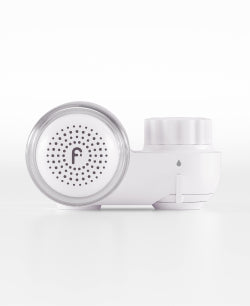
What Filterbaby reduces from your shower water
Before it reaches your skin and hair
(up to)
reduction (up to)
filtered (up to)
Certified
IAPMO Certified to NSF/ANSI 177 standards. Tested reduction performance in lab-certified conditions; plus or minus 6% efficacy fluctuation. When used and replaced as directed. A shower filter does not soften water.
Which Filterbaby is right for you
3 configurations, same filtration standard.


Frequently asked questions
How much chlorine is in tap water?
Is 4 mg/L of chlorine a lot?
Does chlorine evaporate if I let water sit out?
Is chlorine in shower water worse than in drinking water?
How do I find out if my city uses chlorine or chloramine?
Are disinfection byproducts actually dangerous?
Will a shower filter remove disinfection byproducts?
References
US disinfectant residual levels from the EPA Office of Water, Six-Year Review 3 Technical Support Document for Microbial Contaminant Regulations, EPA-810-R-16-010 (December 2016), covering distribution system samples across 34 states. System-level results are also published in EPA's Six-Year Review 4 Compliance Monitoring Data (2012 to 2019).
Maximum residual disinfectant levels and byproduct limits from the EPA National Primary Drinking Water Regulations and the Stage 1 and Stage 2 Disinfectants and Disinfection Byproducts Rules.
Showering and bathing as the dominant contributor to trihalomethane exposure from Luben et al., US EPA Center for Public Health and Environmental Assessment, Journal of Exposure Science & Environmental Epidemiology (2024).
Blood trihalomethane levels and recent showering from Ashley et al., CDC National Center for Environmental Health, Environmental Science & Technology (2020), analyzing NHANES 2001 to 2012.
National bladder cancer case estimate from Weisman et al., US EPA Office of Water, Environmental Health Perspectives (2022).
Unregulated byproduct occurrence and toxicity from Dai et al., Clemson University, Environmental Science & Technology (2026), across 24 US utilities and 61 species; and DiLoreto et al., Georgia Institute of Technology, Environmental Science & Technology (2026), across eight US utilities.
Routes of chloroform exposure during showering from Jo, Weisel and Lioy, Risk Analysis (1990). This remains the standard source for the dermal-to-inhalation split, and no US study has since repeated it. Chloramine population figure as published by the US EPA, which does not state a data year for the estimate.
Filterbaby Pro Series and Diamond Series shower filters are IAPMO Certified to NSF/ANSI 177 standards and designed to reduce up to 99% of chlorine, chloramine, and microplastics; plus or minus 6% efficacy fluctuation from lab-certified testing, when used and replaced as directed. A shower filter does not soften water and does not remove disinfection byproducts formed upstream. This page is provided as an educational reference; it is not medical advice.
Keep reading
- Chlorine vs. chloramine: what's actually in your shower waterA closer look at the two disinfectants and how they differ.
- Hair loss and your shower water: what the research separatesWhat that daily oxidant does, and does not, do to hair.
- How to choose a shower filter: 7 things that actually matterWhat to check once you know your numbers.