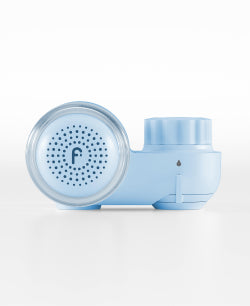
Does a shower filter soften hard water? No, and here is why.
It is the question we get asked most, and the answer is the one least likely to sell a filter. Hardness and chlorine are two different problems, and only one of them fits in a cartridge.
 Written by Filterbaby EditorialWater & Skin Research Team
Reviewed by Filterbaby Dermatology Advisory BoardBoard-certified dermatologists
Written by Filterbaby EditorialWater & Skin Research Team
Reviewed by Filterbaby Dermatology Advisory BoardBoard-certified dermatologists
This is the question our support inbox gets more than almost any other, and the honest answer costs us a sale often enough that most of the category avoids giving it. So here it is up front, before the explanation.

The short answer
No shower filter softens hard water. Not ours, not anyone's, and not for any price. It is not a quality problem or a cost problem. It is a physics problem, and once you see the mechanism it becomes obvious why.
What a good shower filter does is reduce the disinfectant residualThe chlorine or chloramine your utility deliberately leaves in the water so it stays safe all the way to your tap. in your water. That is a real thing, worth doing, and completely separate from hardness. The trouble is that both problems produce vaguely similar complaints, so they get sold as one.
What hardness actually is
HardnessDissolved calcium and magnesium in your water, measured as milligrams per litre of calcium carbonate, or in grains per gallon. is dissolved calcium and magnesium. The USGS puts it plainly: it is the amount of those two minerals in the water, and it is measured as milligrams per litre of calcium carbonate.
Those are the USGS bands. One grain per gallon is roughly 17 mg/L, which is the conversion you need when a softener company quotes you grains and your utility reports milligrams.
You will read everywhere that 85% of US homes have hard water, according to the USGS. We went looking for that figure in the source. It is not in any USGS publication. Not the Water Science School hardness page, not Circular 1332, not Circular 1346, which assesses the public-supply wells most Americans actually drink from and does not discuss hardness at all. What USGS does report: in a national sample of about 2,100 private domestic wells, roughly 60% were hard or very hard. Private wells serve about 15% of the country. That is a real number about a specific population, and it is not the same claim.
Why a filter cannot remove it
Activated carbon works by adsorptionMolecules sticking to the surface of the carbon as water passes over it. It works on organic compounds, not on dissolved mineral ions.. Organic molecules stick to its enormous porous surface. Calcium and magnesium are small, permanently charged inorganic ions, and they have no affinity for that surface at all. Purdue Extension states it without hedging: hardness is not removed by activated carbon to any significant degree.
Removing hardness takes ion exchangeWater passes over resin beads loaded with sodium. Calcium and magnesium swap onto the beads and sodium is released into the water., and the requirements are unforgiving. You need a bed of sulfonated polystyrene resin charged with sodium. The calcium and magnesium trade places with that sodium and stay on the beads. Then, because the beads have a fixed capacity, you have to regenerate them by flooding the tank with concentrated salt brine and flushing the captured minerals down the drain. That cycle runs 60 to 120 minutes and uses about 50 gallons of water.
This is a stoichiometric problem, not an efficiency one. Every gram of resin captures a fixed number of ions. A household softener uses one to two cubic feet of resin plus a separate brine tank because that is what a day of hardness actually weighs. A cartridge the size of your fist has neither the resin volume nor any way to regenerate. Even if you packed one with resin, it would exhaust within hours and then start releasing what it had captured.
What the certification does and does not cover
NSF/ANSI 177The American national standard for shower filtration systems, titled Shower Filtration Systems, Aesthetic Effects. is the only US standard written specifically for shower filters, and it is worth knowing exactly what it says. NSF describes it as the standard for chlorine reduction in shower filtration. It covers three things: material safety, structural integrity, and verified reduction of free available chlorine. To pass, a system must reduce a 2.0 mg/L chlorine challenge by at least 50%.
Hardness, calcium, magnesium and scale appear nowhere in it. We pulled the live NSF certified-products listing while writing this. Six manufacturers, ten products, and every single certified claim across all of them is free available chlorine reduction. One of the listed products is literally named ScaleGuard. Its certification says nothing about scale.
Two more things the standard says out loud that the category tends not to repeat. It is explicitly not a health effects standard, so a 50% reduction of a 2.0 mg/L challenge is an aesthetic benchmark rather than a medical one. And it does not evaluate performance against chloramineChlorine combined with ammonia. More stable in pipes, harder to filter, and used by more than one in five US water systems. at all, which matters given how many US utilities have switched to it.
The standard that does cover hardness is NSF/ANSI 44, for residential cation exchange softeners. There is no shower-filter equivalent, because no shower filter could pass it.
What hard water actually does to skin
Here the evidence gets interesting, and it does not point where the marketing points.
The best mechanistic study is from Sheffield in 2018. Eighty participants, healthy controls and atopic dermatitis patients, washing forearms in water of varying hardness and chlorine. Hard water left significantly more surfactant residue on the skin, and that residue raised transepidermal water lossHow fast water escapes from your skin into the air. The standard measure of skin barrier integrity. and caused irritation, most in patients carrying filaggrin mutations. Softening the water reduced the effect.
We should flag the other half of that result, because it is inconvenient for us. The same study did not find a clear chlorine effect on the skin barrier. Its positive finding was about hardness, which is the thing a shower filter cannot touch.
Then there is the question of whether removing hardness helps. It has been tested properly, twice.
The association between hard water and childhood eczema does exist in observational data, at an odds ratio of about 1.28, but that pooled estimate carries a very low certainty rating. The only US cohort, 962 mother-infant pairs in New Hampshire with tap water sampled from each home, found no association at all across hardness quartiles. And even the largest positive study, 52,950 Danish infants, put the population attributable risk at 2%.
So the strongest evidence in this area is the negative kind. Removing hardness entirely, with the most powerful tool available, did not improve eczema. That is worth knowing before anyone sells you a cartridge on the promise that it will.
- The SWET trial randomised 336 children with moderate to severe eczema in hard water areas to a whole-house ion exchange softener or usual care. At 12 weeks the softener group improved 20% and the usual care group 22%. Mean difference 0.66, p = 0.53. No difference in steroid use either.
- A 2021 systematic review pooled the interventional evidence and found a standardised mean difference of 0.06, with a confidence interval spanning zero and moderate certainty. Its conclusion: no evidence that domestic water softeners improve objective disease severity in established eczema.
The thing you actually feel
None of the above means hard water is imaginary. It means the mechanism is different from the one people assume.
When true soap meets calcium, it forms calcium stearateAn insoluble precipitate formed when the fatty acid salts in real soap react with dissolved calcium. The white film on your shower door., an insoluble precipitate. That is soap scum, and it is the film on your shower door, the dullness in your hair, and the reason you use more product to get the same lather. The USGS says the same thing in one line: in hard water, more soap or detergent is needed to get things clean, whether that is your hands, your hair, or your laundry.
One honest correction, because the internet gets this wrong. That classic reaction is with real soap, meaning fatty acid salts like bar soap and castile. Most modern shampoos and body washes use sulfate and amphoteric surfactants, which tolerate calcium far better and do not form classic lime soap. Hard water still degrades how they perform and still leaves residue. It just is not turning your shampoo into limescale.
And that residue is the link back to the Sheffield study. The problem is less the minerals sitting on your skin than the detergent the minerals leave behind.
What to actually do about hard water
- Find out your number first. Check your utility's annual water quality report. Be aware hardness is not a regulated contaminant and is not on the EPA's secondary standards list, so utilities are not required to report it. If it is missing, call and ask.
- Use an independent lab, not a free test. Penn State Extension puts it bluntly: although many water softening companies offer free hardness testing, it is best to have a third-party evaluation, which will protect you from being oversold.
- If you want soft water, buy a softener. Ion exchange, certified to NSF/ANSI 44, installed on the main line. Expect roughly $500 to $1,500 in hardware, plus salt and a drain connection. Nothing smaller does this job.
- Change the soap before you change the plumbing. Since the mechanism is detergent residue, switching to a gentler, better-rinsing cleanser and rinsing more thoroughly addresses the felt problem directly, for the price of one bottle.
- Treat chlorine as a separate decision. It is a different contaminant with a different solution, and it is the one a shower filter genuinely handles.
What about descaling and anti-scale media
Some filters claim to handle hardness through sequestrationAdditives that interfere with mineral crystals forming, without actually removing the minerals from the water., chelation, or media-induced precipitation. The clearest answer comes from the Water Quality Association, which is the water treatment industry's own trade association and therefore has no reason to undersell its members.
Their position: these technologies may show a measurable hardness reduction depending on how you measure it, but they do not reduce the total calcium or magnesium content of the treated water, and they are not proven to achieve soft water.
The chemistry backs that up. Polyphosphate scale inhibitors work at sub-stoichiometric doses, as little as 0.1 mg/L inhibiting most scale formation. They cannot be binding up the calcium at those levels. They are interfering with crystals forming on surfaces. Every calcium and magnesium ion is still dissolved in the water and still reaches your skin at full concentration.
As for KDF, the copper-zinc media in many shower filters: it works by redox, and it is a legitimate way to reduce free chlorine. It has nothing to do with calcium or magnesium, which are not redox-active here. Worth knowing that we could not find a single independent peer-reviewed study of KDF media in the water filtration literature. The entire evidence base is manufacturer documentation.
Hard water and chlorine are two different problems. A shower filter solves one of them and cannot touch the other. We would rather tell you that than sell you a cartridge for a job it will not do. If your complaint is scale on the glass, soap that will not lather, and film in your hair, that is hardness, and you need a softener or a different cleanser. If your complaint is the smell, dryness after a shower, or what the water is doing to colour-treated hair, that is the disinfectant, and that is the part we handle.
What Filterbaby reduces from your shower water
Before it reaches your skin and hair
(up to)
reduction (up to)
filtered (up to)
Certified
IAPMO Certified to NSF/ANSI 177 standards. Tested reduction performance in lab-certified conditions; plus or minus 6% efficacy fluctuation. When used and replaced as directed. A shower filter does not soften water.
Which Filterbaby is right for you
3 configurations, same filtration standard.


Frequently asked questions
Does a shower filter soften hard water?
Why can't a carbon filter remove hardness?
What does NSF/ANSI 177 actually certify?
Do water softeners help eczema?
Is hard water bad for your hair?
How do I find out how hard my water is?
Do descaling or anti-scale filters soften water?
References
Hardness classification bands and the soap reaction from the US Geological Survey Water Science School, Hardness of Water. Grains-per-gallon conversion and the five-band Water Quality Association scale as reproduced by University of Nebraska-Lincoln Extension (NebGuide G1491) and Penn State Extension, Water Softening (2025).
Private well hardness occurrence from DeSimone, Hamilton and Gilliom, Quality of water from domestic wells in principal aquifers of the United States, 1991-2004, USGS Circular 1332 (2009), approximately 2,100 wells across 48 states. We were unable to locate any USGS source for the widely repeated claim that 85% of US homes have hard water.
Activated carbon and hardness from Kamrin, Hayden, Christian, Bennack and D'Itri, Home Water Treatment Using Activated Carbon, Purdue University Cooperative Extension Service WQ-13. Ion exchange mechanism, regeneration cycle and cost from UNL Extension G1491 and Penn State Extension.
NSF/ANSI 177 scope from NSF International, NSF/ANSI 177 Shower Filter Certification, and the test protocol as described in Plumbing & Mechanical (2005). Certified product claims verified against the live NSF Official Listings for Standard 177, retrieved 23 August 2026.
Hard water, surfactant deposition and skin barrier from Danby, Brown, Wigley and colleagues, Journal of Investigative Dermatology (2018), 80 participants. This study did not observe a clear chlorine effect.
Water softeners and eczema from Thomas, Dean, O'Leary and colleagues, the SWET randomised controlled trial, PLoS Medicine (2011), 336 children; and Jabbar-Lopez, Ung, Alexander and colleagues, systematic review and meta-analysis, Clinical and Experimental Allergy (2021), 16 studies.
US cohort data from Ezzamouri, Palys, Jackson and colleagues, New Hampshire Birth Cohort Study, Clinical and Experimental Allergy (2023), 962 mother-infant pairs. Note this paper carries a 2025 published correction to its calcium carbonate computation. Danish population data from Engebretsen and colleagues, Journal of Allergy and Clinical Immunology (2017), 52,950 infants.
Hard water and hair from Luqman and colleagues, Journal of the Pakistan Medical Association (2016), 76 samples, and International Journal of Trichology (2018), 70 samples; and Srinivasan and colleagues, International Journal of Trichology (2013) and International Journal of Dermatology (2016), 15 volunteers. All are laboratory studies on cut hair. None measured hair loss.
Anti-scale and sequestration technologies from the Water Quality Association, Scale Deposits. Polyphosphate scale inhibition chemistry from Lytle and Edwards, ACS ES&T Water (2023).
Filterbaby Pro Series and Diamond Series shower filters are IAPMO Certified to NSF/ANSI 177 standards and designed to reduce up to 99% of chlorine, chloramine, and microplastics; plus or minus 6% efficacy fluctuation from lab-certified testing, when used and replaced as directed. A shower filter does not soften water. This page is provided as an educational reference; it is not medical advice.
Keep reading
- How much chlorine is in your shower waterThe other half of the question, with the EPA numbers.
- Chlorine vs. chloramine: what's actually in your shower waterWhich disinfectant you have, and why it changes what to buy.
- How to choose a shower filter: 7 things that actually matterThe full checklist, including what to ask any brand.