Hair loss and your shower water: what the research actually separates.
You are finding more hair in the drain and your part looks wider than it did last year. Before you change anything, it is worth knowing which of two very different problems you have, because only one of them has anything to do with your water.
 Written by Filterbaby EditorialWater & Skin Research Team
Reviewed by Filterbaby Dermatology Advisory BoardBoard-certified dermatologists
Written by Filterbaby EditorialWater & Skin Research Team
Reviewed by Filterbaby Dermatology Advisory BoardBoard-certified dermatologists
If your hair feels thinner than it used to and nothing in your routine has changed, the most useful thing you can do is not buy a new product. It is to work out whether your hair is falling out or breaking off, because almost every piece of advice online treats those as the same thing.

Falling out or breaking off
These are two different failures, and they need two different responses.
Hair that fell out came from the follicleThe tiny pocket in the skin that a hair grows out of.. You will find whole strands with a small pale bulb on one end. Causes are genetic, hormonal, nutritional, or a response to illness or stress. This is the dermatologist's territory.
Hair that broke off is a fiber problem. You will find short segments with no bulb, split ends, and a halo of short flyaway hairs standing up along your part. Causes are bleach, dye, heat, UV, repeated washing, tension, and friction. This is the routine-and-inputs territory.
The tell is the bulb. Everything else is guesswork.
The number behind the search
Female pattern hair lossGradual thinning driven by genetics and hormones, usually widening the part rather than creating bald patches. is common, and it gets more common with age. The prevalence series most dermatologists cite puts it at about 12% of women by 29, 25% by 49, and 41% by 69.
Worth saying plainly: that series is from 2001, and no US study in the last decade has replaced it. The largest recent US dataset, the Apple Women's Health Study of 24,435 participants published in 2025, found 1.7% reporting significantly reduced hair with visible scalp. That is a self-reported measure of severe thinning, so it is a floor rather than a like-for-like number.
Either way, a lot of people reach their forties with real pattern hair loss. No filter, shampoo, or serum changes that. Which is exactly why separating it from breakage matters before you spend anything.
Your scalp is the growth environment
This is the finding that reframes the whole question, and it comes from US research.
In a 2018 study run at Procter & Gamble's Cincinnati labs, scalp condition was shown to affect the cuticleThe overlapping outer scale layer of the hair. When it is intact, hair is smooth and strong. When it lifts, hair goes rough and snaps easily. integrity of hair before that hair emerged from the scalp. The authors described the damage signature imposed by an unhealthy scalp as similar in type to bleaching damage. In other words, a hair can arrive at the surface already compromised.
Then, in 24-week and 8-week randomized, placebo-controlledThe strongest common study design. Participants are assigned by chance, and neither they nor the researchers know who received the real treatment. trials published in 2021 and run with the Cleveland Clinic Departments of Dermatology and Pathology, improving scalp condition produced measurable reductions in hair shedding, higher total hair counts, and lower scalp trans-epidermal water loss.
A 2025 study from the same group found scalp barrier disruption and inflammatory markers appearing as early as day 3 after scalp care stopped. Scalp condition is a maintained state, not a permanent one.
Where your shower water comes in
Most tap water is treated with free chlorineThe active chlorine added to tap water as a disinfectant. It is what gives water that pool-like smell. or chloramine. Both are oxidizers, and US lab work at Ashland in New Jersey has imaged exactly what oxidative chemistry does to hair: erosion of the cuticle and the cell membrane complex, cracks in the cortex, and damage that accumulates across repeated cycles rather than resolving between them.
Not sure what your city uses? Your utility reports it every year. You can look your system up through the EPA's local water lookup.
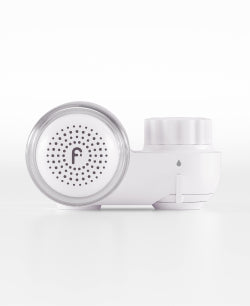
A shower filter reduces that chlorine and chloramineChlorine combined with a little ammonia. It lasts longer in the pipes and is harder to filter than plain chlorine. before the water reaches your scalp. Filterbaby is designed to reduce up to 99% of chlorine, chloramine, and microplastics.
So the honest chain is this: oxidants damage the hair fiber, scalp condition sets fiber quality before emergence, and chlorine is an oxidant reaching your scalp every day. That is a reasonable place to reduce an input. It is not a demonstrated hair outcome, and we are not going to claim it is.
No US study, in any year, has tested tap water or shower water against hair or scalp outcomes. We looked specifically. The closest direct evidence is a 2000 Japanese study of 67 national team swimmers, which found chlorine inside the hair cortex and complete cuticle loss under electron microscopy, but which never measured hair counts, and which attributed the cuticle damage mainly to friction with water. The widely repeated line that it proved chlorine does not cause hair loss comes from a newspaper column, not the paper.
What actually helps
Hair responds to consistency over months, not intensity over days. None of this replaces a dermatologist, especially if your part is widening or your scalp is inflamed.
- Work out which problem you have first. Check for the bulb. If hair is coming out at the root and your part is widening, book the dermatologist before you buy anything.
- Treat the scalp like skin. The US trials above put scalp barrier condition and shedding in the same conversation. Tightness, flaking, and itch are signals worth acting on.
- Reduce the oxidative load. Filter the chlorine and chloramine, and keep the water lukewarm rather than hot.
- Cut the mechanical damage. Bleach, flat irons, and tight styles are what the US imaging studies actually measured. They do more visible harm than your water does.
- Judge it over a season. New growth emerges at roughly half an inch a month. A month is not a verdict.
A matched pair showing hair density or part width.
Two square images, same parting, same light, same camera height. Signed consent, dated, timeframe stated. Must not imply regrowth, which the post explicitly says a filter cannot do.What Filterbaby reduces from your shower water
Before it reaches your skin and hair
(up to)
reduction (up to)
filtered (up to)
Certified
IAPMO Certified to NSF/ANSI 177 standards. Tested reduction performance in lab-certified conditions; plus or minus 6% efficacy fluctuation. When used and replaced as directed. A shower filter does not soften water.
Which Filterbaby is right for you
3 configurations, same filtration standard.


Frequently asked questions
Does chlorine cause hair loss?
How do I know if it is breakage or shedding?
Is there US research on shower water and hair?
How much hair loss is normal?
Does scalp health really affect hair quality?
Will a shower filter help my color-treated hair?
Which Filterbaby is best for hair?
References
Prevalence of female pattern hair loss by age from Norwood's incidence series (2001), reproduced in Levy and Emer, International Journal of Women's Health (2013), and consistent with the 2026 CMAJ review of female pattern hair loss.
Self-reported hair thinning in a US cohort from Wolf et al., Apple Women's Health Study, Journal of Clinical Endocrinology & Metabolism (2025), 24,435 US participants.
Scalp condition and pre-emergent hair cuticle integrity from Schwartz et al., Procter & Gamble, Cincinnati, Journal of Cosmetic Dermatology (2018).
Scalp barrier, trans-epidermal water loss, and hair shedding from Davis et al., Procter & Gamble with the Cleveland Clinic Departments of Dermatology and Pathology, International Journal of Cosmetic Science (2021), two randomized double-blind placebo-controlled trials; and Locker et al., same group, International Journal of Cosmetic Science (2025), on scalp barrier decline within days.
Oxidative damage to the hair cuticle, endocuticle, and cell membrane complex imaged by atomic force microscopy, from McMullen and Zhang, Ashland Specialty Ingredients, Bridgewater, New Jersey, Journal of Cosmetic Science (2016 and 2020).
Chlorine within the hair cortex and cuticle loss in competitive swimmers from Nanko et al., The Journal of Dermatology (2000), 67 Japan National Swimming Team members and 54 controls. This study measured fiber and pigment damage; it did not report hair counts.
Several studies cited here were conducted or funded by consumer goods manufacturers, and the institution is named in each case. Filterbaby Pro Series and Diamond Series shower filters are IAPMO Certified to NSF/ANSI 177 standards and designed to reduce up to 99% of chlorine, chloramine, and microplastics; plus or minus 6% efficacy fluctuation from lab-certified testing, when used and replaced as directed. A shower filter is not a treatment for hair loss and does not regrow hair. This page is provided as an educational reference; it is not medical advice. Consult a board-certified dermatologist for diagnosis and management of hair loss.
Keep reading
- How much chlorine is in your shower waterThe EPA numbers behind the oxidant reaching your scalp every day.
- Chlorine vs. chloramine: what's actually in your shower waterThe two disinfectants, and why one is much harder to filter.
- How to choose a shower filter: 7 things that actually matterThe full checklist, including what to ask any brand.