Keratosis pilaris and your shower water: the overlooked factor.
You exfoliate, you moisturize, and the little bumps on your arms come right back. They are not going anywhere on their own, but the one input most routines never check is the water you shower in.
 Written by Filterbaby EditorialWater & Skin Research Team
Reviewed by Filterbaby Dermatology Advisory BoardBoard-certified dermatologists
Written by Filterbaby EditorialWater & Skin Research Team
Reviewed by Filterbaby Dermatology Advisory BoardBoard-certified dermatologists
If you have small, rough bumps on the backs of your arms or your thighs that never fully clear no matter what you do, you are in good company. Keratosis pilaris is one of the most common skin findings there is, and one of the most frustrating, because the usual advice treats the symptom and skips a daily input that quietly works against you.

The bumps that will not budge
You scrub, you slather on lotion, the arms look better for a day, and the bumps return. That cycle is normal for keratosis pilaris, and it leads a lot of people to assume they are doing something wrong. They usually are not. The condition waxes and wanes on its own, and it tends to be most stubborn exactly where skin runs driest.
What keratosis pilaris actually is
Keratosis pilaris happens when keratinA tough protein your skin makes. In keratosis pilaris it builds up and plugs the hair follicle., a protein your skin naturally produces, builds up and plugs the opening of a hair follicle. Each plug raises a tiny, rough bump, and sometimes a little redness around it. It is harmless, it is not contagious, and it is strongly genetic, which is why it runs in families and often shows up alongside dry skin or an atopic tendency.
The important part for what follows: the bump is the keratin plug. No shower filter, lotion, or scrub dissolves keratin from the outside in a single step. Managing keratosis pilaris is about softening and gradually clearing those plugs while keeping the surrounding skin as calm and hydrated as possible.
Why dry skin makes it worse
Here is the lever you can actually pull. Keratosis pilaris looks and feels worse on dry skin. When the skin barrierThe outer layer of skin that holds moisture in and keeps irritants out. is dry and stressed, the bumps get rougher, redder, and more noticeable, and the itch-scratch temptation goes up. When the same skin is well hydrated, the bumps soften and fade into the background, even though the underlying tendency has not changed.
So the practical question is not "how do I cure this," it is "what is drying my skin every day, and can I reduce it." That is where the shower comes in.
Where your shower water comes in
Most tap water is treated with free chlorineThe active chlorine added to tap water as a disinfectant. It is what gives water that pool-like smell. or chloramine. Both are oxidizers that strip the skin's protective lipids and raise trans-epidermal water loss, the rate your skin leaks moisture. Add hot water, which dries skin further, and your daily shower can quietly keep the barrier in exactly the dry, stressed state that makes keratosis pilaris stand out.
Not sure what your city puts in the water? Your utility reports it every year. You can look your system up through the EPA's local water lookup and see whether you are on chlorine or chloramineChlorine combined with a little ammonia. It lasts longer in the pipes and is harder to filter than plain chlorine., and at what level.
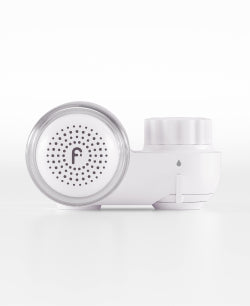
A shower filter reduces that chlorine and chloramine before the water reaches your skin. It will not touch the keratin plug, and it is not a treatment for the condition. What it does is remove one daily drying input, which supports the hydration side of managing the bumps. For a condition where dryness is the difference between "barely notice it" and "rough and red," that input is worth controlling. Filterbaby is designed to reduce up to 99% of chlorine, chloramine, and microplastics.
A realistic routine
Keratosis pilaris responds to consistency, not intensity. Aggressive scrubbing makes it angrier. None of this replaces a dermatologist's plan, especially if your skin is inflamed. Think of it as the daily layer underneath their guidance.
- Filter and cool down the shower. Reduce the chlorine and chloramine, and keep the water lukewarm rather than hot, so you are not drying the skin while you wash.
- Exfoliate gently, not harshly. A chemical exfoliant with lactic or salicylic acid a few times a week tends to beat a rough scrub, which can irritate the bumps.
- Moisturize on damp skin. Within a few minutes of getting out, while the skin is most receptive, to lock in water and soften the surface.
- Give it weeks, not days. Keratosis pilaris improves slowly and comes and goes. Judge a routine over a month or two, not a single shower.
Filtering your shower water will not clear keratosis pilaris, because nothing applied to the outside clears the keratin in one step. What it can do is take away a daily drying stressor so the rest of your routine, and your own skin, have a calmer surface to work with.
A close-up pair showing keratosis pilaris texture on the upper arm.
Two square macro images, same arm, same light, same distance. Signed consent and timeframe. KP is not curable, so caption must frame this as appearance only.What Filterbaby reduces from your shower water
Before it reaches your skin and hair
(up to)
reduction (up to)
filtered (up to)
Certified
IAPMO Certified to NSF/ANSI 177 standards. Tested reduction performance in lab-certified conditions; plus or minus 6% efficacy fluctuation. When used and replaced as directed. A shower filter does not soften water.
Which Filterbaby is right for you
3 configurations, same filtration standard.


Frequently asked questions
Can a shower filter cure keratosis pilaris?
Does hot, chlorinated water make it worse?
What actually helps keratosis pilaris?
Will filtering my shower water clear the bumps?
Which Filterbaby is best for dry, bumpy skin?
References
American Academy of Dermatology and National Institutes of Health overviews of keratosis pilaris: a common, benign, genetic condition of follicular keratin plugging, managed rather than cured.
Published research on chlorinated water and skin-barrier function, including effects on the stratum corneum's water-holding capacity and trans-epidermal water loss.
Filterbaby Pro Series and Diamond Series shower filters are IAPMO Certified to NSF/ANSI 177 standards and designed to reduce up to 99% of chlorine, chloramine, and microplastics; plus or minus 6% efficacy fluctuation from lab-certified testing, when used and replaced as directed. A shower filter does not soften water. This page is an educational reference; it is not medical advice. Consult a dermatologist for diagnosis and management of keratosis pilaris.
Keep reading
- Eczema and your shower water: the trigger most routines overlookThe same barrier-and-chlorine story, for skin that is dry and easily irritated.
- Chlorine vs. chloramine: what's actually in your shower waterThe two disinfectants drying your skin, and how they differ.
- Can tap water cause acne? The science, explainedAnother way the water you wash with can show up on your skin.